Photometrics & Flux
Lumens measure total visible light emitted, while candela and foot-candles determine directional intensity and surface illuminance.
Color Metrics
CCT indicates warm or cool visual appearance in kelvins, while CRI and R9 measure true object color rendition.
Installation Types
Type A, B, A/B, and C designations dictate ballast compatibility, direct line-voltage wiring, or external driver requirements.
Fixture Ratings
Environmental damp/wet ratings, IP codes, and enclosed-fixture approvals prevent thermal and moisture-related failure.
Light Output and Power
Lumens: Luminous Flux
Lumens (lm) express the total light output of a source, weighted for human visual sensitivity. Compare lumen figures to understand output, then consider where that light goes. A lamp's stated lumens and the light leaving a complete fixture may differ because the fixture's optics and other components affect the result.
Watts and Kilowatt-Hours
Watts (W) measure electrical power. Kilowatt-hours (kWh) measure energy used over time: power in kilowatts multiplied by operating hours. A wattage comparison should include any ballast or driver power that is outside the lamp's stated input. For selectable products, use the setting planned for the project.
Luminous Efficacy
Efficacy is light output divided by electrical input, expressed in lumens per watt (lm/W). Check the measurement boundary: an LED component, a complete lamp, and a full luminaire are different comparisons. Compare figures at the relevant settings and include the associated control gear when evaluating system power.
Illuminance, Lux, and Foot-Candles
Illuminance is the amount of light arriving on a surface per unit area. One lux (lx) is one lumen per square meter; one foot-candle (fc) is one lumen per square foot. One foot-candle is approximately 10.764 lux. Installed illuminance depends on output, distribution, distance, aiming, and the surrounding space.
Candela: Luminous Intensity
Candela (cd) measures luminous intensity in a particular direction. It helps describe how concentrated a beam is. Two lamps with similar total lumens can have different intensity patterns and produce different light levels at the same location.
Color and Distribution
Correlated Color Temperature: CCT
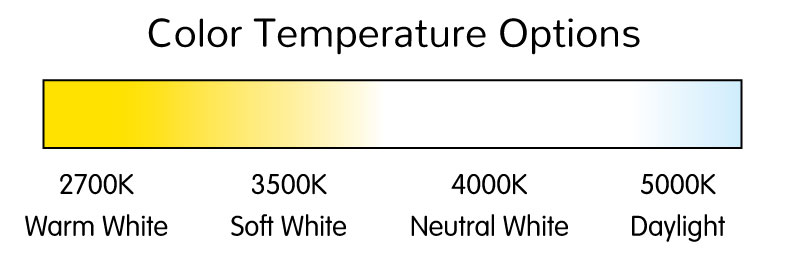
CCT describes the color appearance of a white light source in kelvins (K), by reference to the color of a heated theoretical radiator. Lower values generally appear warmer; higher values generally appear cooler. CCT does not describe brightness or color rendering, and two products with the same nominal CCT can still look different.
Color Rendering Index: CRI
CRI describes how a source renders object colors compared with a reference source of comparable color temperature. A higher general CRI usually indicates closer agreement for the test colors. It is not a percentage of daylight or a complete account of every color: other information, such as R9 (saturated-red rendering) or TM-30 data, can help when color appearance is a project priority.
Beam Angle and Field Angle
For a directional source, beam angle is measured between directions where intensity falls to 50% of the maximum; field angle uses the 10% level. These are intensity thresholds, not percentages of total lumens. Light can extend beyond the beam angle, and an asymmetric beam can have different angles in different planes.
Light Distribution and Photometric Data
Distribution describes how light is directed through space. Photometric data, often supplied in an IES file, supports calculations of illuminance and coverage for a particular layout. The lighting distribution and patterns guide explains how beam shape, mounting position, and fixture optics affect that layout.
Selectable Wattage, CCT, and Beam
A selectable feature provides specified settings on a particular model. Wattage selection changes the operating power setting; CCT selection changes nominal color temperature; beam selection changes the available distribution setting. A beam option may be selected when ordering rather than adjusted on the installed lamp; check how the particular product is configured. A product offering one of these features does not necessarily offer the others. Check the output and ratings for the chosen configuration.
Connections, Installation Types, and Controls
Lamp Base and Lamp Format
The base is the connection to the socket or lampholder, such as E26, GX16d, or G13. A format designation, such as PAR38 or T8, describes a different aspect of the lamp. Use the lamp base guide to identify the complete connection code and the other details needed for a replacement.
Ballast and LED Driver
A ballast provides the starting and operating conditions required by a fluorescent or HID lamp. An LED driver regulates the electrical power supplied to LEDs and may be built into the lamp or mounted separately. An existing ballast can remain only when the replacement is designed for that arrangement and the combination is compatible.
Type A, Type B, Type A/B, and Type C LED Lamps
These labels describe how certain LED replacement lamps receive power. They do not identify brightness, base size, dimming capability, or every installation requirement.
| Type | Power Arrangement | What to Verify |
|---|---|---|
| Type A | Operates through a compatible existing ballast. | The exact ballast model, supported lamp configuration, and the replacement manufacturer's compatibility information. |
| Type B | Operates from line voltage through an internal driver, using appropriately wired lampholders in a converted or factory-wired luminaire. | For a fluorescent retrofit, the required ballast bypass or removal, plus the exact lamp's supply, lampholder, wiring, and labeling instructions. |
| Type A/B | A model designed for both supported ballast operation and a specified line-voltage arrangement. | The instructions for the selected mode. Compatibility in one mode does not establish compatibility in the other. |
| Type C | Operates from a separate, matched LED driver. | The specified lamp-and-driver combination, installation arrangement, and any controls used with that system. |
The lighting technologies guide explains how these arrangements affect retrofit planning. Electrical modifications must follow the product instructions and applicable requirements and be performed by qualified personnel.
Input Voltage
Input voltage identifies the supply for which a product or specified system is rated. Check the complete rating and the operating arrangement. A lamp's base, physical fit, or familiar appearance does not establish its input voltage.
Dimming
A dimmable product is designed to reduce light output using a supported control method. Phase-cut and 0–10V controls are different systems. Confirm the exact lamp or driver, control model, voltage, load, and permitted dimming range. “Dimmable” does not mean compatible with every dimmer, and selectable wattage is not the same feature as dimming.
Power Factor and Total Harmonic Distortion
Power factor (PF) is the ratio of real power to apparent power; it is separate from lumens per watt. Total harmonic distortion (THD) describes harmonic distortion relative to the fundamental electrical waveform. Check whether a THD figure refers to current or voltage and the conditions under which it was reported.
Fixture and Environment Ratings
Dry, Damp, and Wet Locations
These location designations address moisture exposure. A dry location is not normally subject to dampness; a damp location can have moisture or condensation without the direct water exposure associated with a wet location. Check the complete lamp and fixture markings for the installation and any stated restrictions.
Enclosed-Fixture Suitability
This identifies whether the product is suitable for use in the stated enclosed-fixture conditions, where heat can accumulate. A damp-location, wet-location, or IP rating does not establish enclosed-fixture suitability. Check that approval separately, together with temperature limits and permitted orientation.
Ingress Protection: IP Ratings
An IP code describes specified protection provided by an enclosure against access, solid objects, and water under defined test conditions. Read the actual code and product instructions; “IP rated” by itself is incomplete. An IP designation does not replace the other electrical, location, and thermal requirements for the installation.
Service Life and Test Methods
Rated Life and L70
Read the basis of a rated-life claim. L70 refers to lumen maintenance at 70% of initial light output. A reported or projected number of hours to L70 describes that light-output threshold under stated conditions; it does not mean that every lamp will operate until that time or fail when it reaches it.
Driver failure, other component failures, and unacceptable color change can also end useful service. Lumen maintenance and whole-product reliability answer different questions.
Warranty
A warranty sets the manufacturer's coverage and conditions. It is separate from a rated-life or lumen-maintenance claim. Check the actual warranty for the model, including its term, operating conditions, exclusions, and claim process.
LM-79 and LM-80
LM-79 is an IES method for optical and electrical measurements of solid-state lighting products under specified test conditions. LM-80 addresses maintenance of light-output characteristics of LED packages, arrays, and modules. They have different scopes. A reference to either test method alone does not establish the service life of the complete lamp or fixture.
Apply the Terms to the Product You Are Comparing
Use the HyLite specification library to match the full model number and selected configuration to its current documents. If a rating or installation detail is unclear, contact HyLite with the product and fixture information.
For project planning, visit LED retrofit resources for electrical contractors. For the other selection guides, return to the Lighting Knowledge Center.
Technical References
- IES lighting definitions, including CRI, beam angle, and field angle.
- U.S. Department of Energy: LED Basics, covering efficacy, color quality, and product life.
- UL Solutions: LED retrofit luminaire conversion kit guidance.
- IEC 60529: Degrees of protection provided by enclosures.
- IES guidance on LED product lifetime prediction, LM-79 measurements, and LM-80 maintenance measurements.
 English
 Spanish
 French
 Arabic
 Ukrainian
 Portuguese
 German
 Italian
 Russian
 Dutch