System Operation
Filament, arc tube, phosphor discharge, and semiconductor operation define fixture power requirements.
Retrofit Paths
Direct lamp swaps, ballast-bypass wiring, or full luminaire conversions depend on existing gear.
Thermal & Enclosures
Operating temperature, driver electronics, and enclosed housing ratings dictate lamp performance and lifespan.
True Input Power
Energy calculations require total system wattage including ballast or driver losses, not nominal lamp watts.
Identify the Existing Lighting System
Read the lamp and fixture labels before making a product selection. A shape designation such as PAR38 or T8 can also appear on an LED replacement, so the shape alone does not identify the operating technology.
| Technology | How It Works | Useful Information to Collect |
|---|---|---|
| Incandescent and Halogen | A heated filament produces light. Halogen is a type of incandescent lighting that uses a halogen-containing gas fill. | Lamp model, voltage, base, reflector or PAR format, beam, and dimmer. Record any transformer used by a low-voltage system. |
| Linear Fluorescent | A discharge in mercury vapor produces ultraviolet energy that a phosphor coating converts into visible light. A ballast regulates operation. | Tube model and length, ballast model, number of lamps, lampholders, and controls. |
| Compact Fluorescent (CFL) | The fluorescent process is packaged into a smaller lamp. Commercial pin-base versions commonly use a separate ballast. | Complete base code, pin configuration, ballast label, lamp orientation, and fixture space. |
| High-Intensity Discharge (HID) | An electrical arc produces light within an arc tube. This family includes metal halide, high-pressure sodium, and mercury-vapor lamps. | Exact lamp and ballast, supply voltage, base, reflector, housing dimensions, and mounting position. |
| Light-Emitting Diode (LED) | Semiconductor light sources operate with driver electronics, which may be inside the lamp or separate from it. | Complete lamp or fixture model, driver, optics, settings, controls, and installation ratings. |
If the connection is unfamiliar, use the lamp-base identification guide. Keep the full model and base markings; a similar appearance is not enough to select the replacement.
Choose What Will Change During the LED Retrofit
The scope of work depends on the selected replacement and the condition of the existing fixture. Three approaches are worth comparing:
Replace the Lamp Using an Approved Existing Electrical Arrangement
Some LED replacement lamps can operate without changing the fixture wiring. In a ballast-compatible fluorescent replacement, the existing ballast stays in service and must be an approved match for the exact LED lamp and operating configuration. It also remains a component that may need maintenance later.
Convert the Fixture Using the Specified Retrofit Components
A ballast-bypass lamp requires the approved supply connection with the old ballast bypassed or removed. Other retrofit systems use a matching external LED driver. These are different installation arrangements; the lamp's appearance does not identify which one applies.
Use the Type A, Type B, Type A/B, and Type C explanations to understand the labels. A qualified installer should follow the product's installation instructions and host-fixture requirements. UL Solutions explains how retrofit-kit components, markings, and identified fixtures work together.
Replace the Complete Fixture
A new fixture may be the more suitable option when the existing housing is damaged, its optical system does not suit the task, or the proposed retrofit cannot support the required controls or installation conditions. Compare the complete installed cost and lighting result for each workable approach.

Compare the Performance That Matters in the Space
Light on the Task
Compare output and distribution together. A lamp's total lumens do not show how much light will reach a workbench, aisle, wall, or platform. The distribution and beam-pattern guide explains the role of optics and mounting position.
Color Quality
Choose the color temperature and color-rendering performance needed for the application. Evaluate the appearance alongside any lighting that will remain in service.
Controls & Dimming
Match the lamp and driver to the actual dimmer, switching system, sensors, and emergency-lighting equipment. Dimming capability belongs to the selected product and control combination.
Heat & Fixture Conditions
LED products still generate heat. Enclosed-fixture suitability, compartment dimensions, operating temperature, and mounting orientation can affect the selection. A moisture-location rating answers a different question from enclosed-fixture approval.
Service and Maintenance
Consider access to the lamp, the components retained during the conversion, and future replacement parts. Lumen-maintenance information, driver reliability, and warranty coverage describe different aspects of service life.
The Department of Energy's LED Basics guide explains why performance varies among LED products and why the source, power supply, and fixture must be considered together. Definitions of specification terms are in our lighting terminology guide.
Compare Energy Use With Total System Input Power
For a fixed operating setting, energy use in kilowatt-hours equals system input watts multiplied by operating hours, divided by 1,000. Use documented or measured input for the complete system, including any ballast or driver losses. If a figure already represents complete system input, do not add those losses again.
Calculate the existing and proposed systems separately, then subtract the proposed energy use from the existing energy use. This also allows for a change in operating hours.
| System | Total Input Power | Annual Energy Use |
|---|---|---|
| Existing Lighting | 4,000 watts | 4,000 × 3,000 ÷ 1,000 = 12,000 kWh |
| Proposed Lighting | 1,600 watts | 1,600 × 3,000 ÷ 1,000 = 4,800 kWh |
| Calculated Difference | 2,400 watts at those settings | 7,200 kWh per year |
This is a calculation example, not a performance claim for a HyLite product. Where schedules, occupancy controls, or dimming change the operating state, use measured average input or calculate the power and hours for each state. Equipment, labor, maintenance, and the electricity rate structure also matter when comparing project costs.

Find the Relevant HyLite Replacement Family
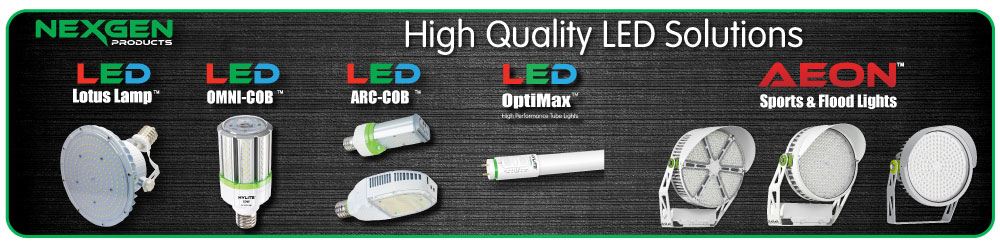
Halogen PAR
Compare Lotus PAR56 and PAR64 retrofit options or the Lotus PAR38 for the existing format, connection, and lighting task.
Four-Foot Fluorescent Tubes
The current 12W/15W/18W OptiMax tube is Type B, ballast bypass, and non-dimmable. Older OptiMax products may use a different arrangement.
Commercial CFL
Review Omni-Bulb and Plug-In VL options. The current 8–15W models are not suitable for enclosed fixtures. Ballast-compatible operation requires the approved lamp-and-ballast combination.
High-Intensity Discharge (HID)
Use the HID replacement guide to narrow the options by the existing lamp, available fixture space, electrical arrangement, and required distribution.
Match the proposed model to its specification and installation documents. For help with a product match, contact HyLite with the lamp and fixture details. The electrical contractor page includes a checklist for assembling that information.
Technical References
- Illuminating Engineering Society: tungsten-halogen lamps and fluorescent lamps.
- U.S. Department of Energy: HID lamp technologies.
- ENERGY STAR: LED operation and heat management.
 English
 Spanish
 French
 Arabic
 Ukrainian
 Portuguese
 German
 Italian
 Russian
 Dutch