Screw Bases (E26 & EX39)
Medium and mogul screw threads specify mechanical socket diameter, not operating voltage or driver type.
Pin-Base CFLs
Keyed 2-pin (G24d) and 4-pin (G24q/GX24) bases require exact pin spacing and ballast compatibility verification.
PAR & Prong Bases
Mogul end-prong (GX16d) and PAR sockets require verifying physical can clearance and retainer ring fit.
Linear Bi-Pin (G13)
Medium bi-pin sockets do not determine wiring paths—always confirm shunted vs. non-shunted lampholders.
Common Lamp Bases and What to Record
Read the complete code, including extra letters and any number after a hyphen. If the marking is missing or illegible, keep photographs of the lamp, its connection, and the fixture label. Have a qualified person inspect an inaccessible connection or electrical components with power safely disconnected.
| Base Code | Connection | What to Check |
|---|---|---|
| E26 | Medium Edison screw base, nominally 26 mm in diameter. | Record the lamp format and input requirements as well as the base. E26 describes the connection, not the operating voltage. |
| E39 | Mogul Edison screw base, larger than E26. | Identify the fixture's existing lamp and ballast, if present. The screw connection does not establish whether an LED replacement uses or bypasses that ballast. |
| EX39 | Extended mogul screw base. | Keep the X in the identification. Check the lamp and socket specifications rather than assuming E39 and EX39 are interchangeable. |
| GX16d | Mogul end-prong connection used on some PAR lamps. | Record the complete lamp model and PAR size, then check the connector, retaining hardware, and available space. |
| G24d | Two-pin compact-fluorescent base family. | Record the full keyed variant, such as G24d-1, G24d-2, or G24d-3, and the existing ballast information. |
| G24q | Four-pin compact-fluorescent base family. | Record the complete code, including the suffix. Four pins alone do not identify the correct replacement. |
| GX24 Variants | A related family of keyed compact-fluorescent connections. | Record GX24, the d or q designation, and the final number exactly. Check the replacement's documented socket and operating-mode compatibility. |
| G13 | Medium bi-pin connection found on many linear fluorescent and LED tubes. | Record tube length, full lamp model, ballast details, and the proposed LED installation type. The pins do not identify the electrical configuration. |
A base code does not establish supply voltage, wattage, dimming capability, or suitability for an enclosed fixture. Find those requirements in the documents for the exact replacement model.
Separate the Base From the Lamp Format
Names such as PAR38, PAR56, PAR64, and T8 describe a lamp format; E26, GX16d, and G13 describe a connection. Record both. A replacement can have the expected base and still be too long, too wide, or unsuitable for the fixture's retaining hardware.
For example, the HyLite Lotus PAR38 uses an E26 base. That does not make its dimensions, beam options, or control requirements the same as another E26 lamp. For directional applications, review the available Lotus PAR38 beam options alongside physical fit.
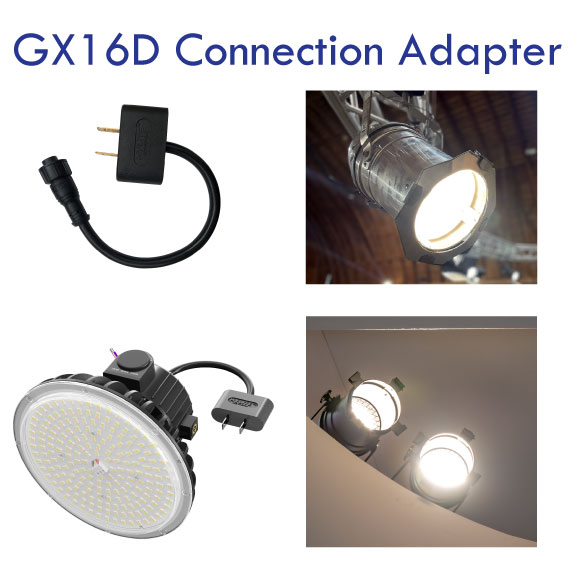
The physical connection is the starting point, but electrical requirements, mounting hardware, fixture dimensions, and light distribution must also be checked before installation.
G24 and GX24: Keep the Complete Code
Compact-fluorescent bases use different pin arrangements and keyed variants. A label such as "G24 replacement" is not enough to identify every compatible socket or electrical arrangement. The letters and suffix matter when checking the original lamp against a replacement's compatibility information.
Some LED replacements are designed to fit more than one listed base variant. Treat that as a feature of the specific product, not a rule that makes all G24 and GX24 sockets interchangeable. If the replacement operates with a ballast, verify the exact ballast model and the permitted lamp configuration.
For the current HyLite 8–15W Omni-Bulb and Plug-In VL lamps, the specification sheets direct customers to contact HyLite about a ballast that is not listed before proceeding. Those models are also not suitable for enclosed fixtures. Review the applicable documents under CFL replacement options; a compatible connection does not remove either requirement.
G13 Tube Bases: Check How the Lamp Receives Power
Similar-looking LED tubes may operate from a compatible fluorescent ballast, from line voltage, or from a matched external LED driver. Those are different installation arrangements. Type A LED tubes generally use an approved compatible ballast. Type B tubes use an approved direct-wire arrangement, while Type C systems use a matched external LED driver. Always check the particular product's installation instructions.
The G13 base does not tell you whether the lampholder is shunted, how the fixture is wired, or whether the replacement requires power at one or both ends. Follow the exact lamp's instructions for the permitted lampholders and wiring configuration; do not apply one tube model's instructions to another.
The current HyLite OptiMax 12/15/18W tube, model HL-GT8-4B-12-18W-3065K, is a Type B product and is non-dimmable. Its ballast-bypass requirements must be accounted for when replacing fluorescent lamps.
Check the Fixture Around the Connection
Finding the correct base is only one part of evaluating a commercial LED retrofit. Review the existing fixture and operating conditions before ordering:
Space and Support
Compare the replacement's dimensions and weight with the housing, reflector, lens, socket, and retaining hardware.
Use adapters or accessories only where the applicable product instructions permit them.
Electrical Arrangement
Confirm supply voltage, any existing ballast or transformer, the intended installation method, and control compatibility.
Operating Conditions
Check mounting orientation, temperature limits, moisture rating, and any enclosed-fixture restrictions.
Lighting Result
Confirm that the replacement's output and light distribution suit the task and mounting position.
Choosing a replacement may involve keeping a suitable fixture, converting it using a compatible product, or replacing the fixture. Review the HID replacement options and current product documentation to evaluate the appropriate retrofit approach.
Need Help Identifying a Replacement?
Send HyLite the existing lamp model and full base code, readable photographs of the connection and fixture label, available dimensions, and known electrical and control information. Include the quantity and where the fixtures are used. These details make the product question specific enough to review.
Contact HyLite or use the specification library to check a model you are already considering. For a larger job, include project quantities, installation conditions, and available fixture photographs when requesting a recommendation.
Identification References
Manufacturer catalogs are useful for checking base nomenclature. Compatibility still comes from the documents for the replacement being installed.
- LEDVANCE Pin-Base Socket Compatibility Guide — Examples of complete G24 and GX24 codes and product-specific installation modes.
- Signify PL LED Lamp Brochure — Two-pin and four-pin base designations.
- SATCO catalog examples identify GX16d as mogul end prong, EX39 as extended mogul, and G13 as medium bi-pin.
 English
 Spanish
 French
 Arabic
 Ukrainian
 Portuguese
 German
 Italian
 Russian
 Dutch